Map of the Camino Frances

Wednesday, October 3, 2018

Memories of the Meseta - 1 (of many)

As we left our better than usual albergue dinner, we decided to walk to the Plaza Mayor to see the locals sitting on benches (older ones) and running around, riding bikes and shouting (younger ones). Turning a corner we found a band of about 12 young musicians, all dressed in the same type of tee-shirt, playing familiar tunes.


The local ladies danced, and the local men drank beer and tapped their feet. One tune merged into another and the musicians`stamina was impressive.

In another village (Fromista) we were able to get into St. Martin, a heavily renovated church (originally built in 1066 while William the Conqueror was visiting England for the first time) of stone. There is no stone in the area so it would have had to be brought in, which would have been no small cost in both labour and finances.To modern tastes it is a lovely calm place, but would have been brightly painted, as well as being extremely well carved and ornamented.

the two round towers are rare

but the rest is a classic design

well executed carvings...

of myths and legends well known to those at the time....

but now forgotten

a rare black madonna and child

I wish you could hear as well as see this lovely moment
While we sat there, only two or three others milling around, another pilgrim sitting in front of us started to sing. Rapt, we sat still as she let her voice fill the space, its acoustics shaping the tune and swirling it around columns to our ears. After about 10 minutes she got up and left. We just looked at each other, and finally exhaled.

Later we found her at a cafe bar and thanked her for her gift to us. She was French, and had taken part in a UNESCO Youth Forum at which a piece of music was composed and sung in praise of peace. What she sang in San Martin was part of that music.

Our other musical incident (so far) was in the small town of Carrion de los Condes, in the 12th century church Santa Maria del Camino that was built to celebrate the defeat of the Muslims. Apparently, as part of the surrender agreement, Christians had to hand over 100 virgins every year to the Moorish overloads. Praying to be rid of this dreadful tribute duty, a herd of bulls attacked the Moors and ran them off. Not surprisingly, a bull was carved into the exterior arch, as well as some no doubt relieved and happy virgins.

Finding the church open (most of them are closed when we pass by) we went in to have a look. within 5 minutes about 20 other pilgrims came in, along with 3 nuns. One, in her early 20s, sat at a piano and sang a series of lovely songs - not hymns but old pieces in Latin. Another young nun`s voice sometimes accompanied her. There was a short blessing to all pilgrims, then more music. It was hard to keep the old peepers dry.

Another lovely surprise. I wonder the Camino will give us next.

Tuesday, October 2, 2018

Don't mess with the Meseta

We have left Burgos and now embark on the long crossing of the Meseta. 
Similar to the English 'mesa', the Camino's Meseta is a broad tableland that stretches from Burgos all the way to Astorgo, more than two weeks of walking. When on top of one of the Meseta altos, one can see all the other table tops at the same height, indicating how this land looked until erosion has slowly lowered some to a level below, so large, broad fields stretch out between and below the intermittent Meseta tabletops. 

Made of limestone, the eroded flat lands are really only good for growing wheat, which has been harvested, and the occasional field of sunflowers, which has yet to be harvested, the upright, brown, nodding seed heads looking like pilgrims praying to the sun. 

It is dusty and hot, although the mornings, which stay dark later now that we have passed the equinox, are cooler and we try to get going before the sun rises but while it is light enough to see, so that we can get a couple of hours in before the sun's heat intensifies.

The villages are all unique and yet they start to blend into each other, with stone and brick walls, red ceramic tile and brown metal shades that meld into the landscape as our steps take us onward. Some of the old places are adobe, made of sundried mud and straw. These don't last as long as brick, which doesn't last as long as stone, and deserted houses have crumbled walls and rooves open to the sky. The first thing we see and the last thing that can be seen is always a church tower, and even the smallest villages seem to have more than one of these. 

The cultivated fields are mostly gold stubble, with the wheat and hay baled in huge ten bales high and ten bales wide walls, ready to be collected and stored or shipped. Other fields are fallow, with grasses growing tall amid wildflowers and seed pods. This part of Spain has produced grain for a large part of Europe for a long time, mostly wheat but also some oats and barley. 

There is little shade, although we are grateful to see and maybe walk alongside the odd line of poplars that rustle in the breeze and tremble with birdsong. some of these have obviously been planted along the camino and we thank whoever did that so many years ago for our benefit today. A small river, irrigation ditch or canal will produce a willow or two, grasses and bullrushes. The colours of our days are rich but continuous: gold fields, green trees, blue, blue, blue sky. On some days we walk along Roman roads, still cobbled, so straight that all we can see ahead is a long line of pilgrims. We marvel at the thought of the millions and millions of feet that have walked along these roads that have moved, ramrod straight, across the landscape for almost 2 millennia.

It is a part of the Camino both loved and hated by pilgrims for messing with perceptions of time and distance.


Burgos Cathedral Part 3

Yes, I am sorry about this, but I can't help myself. Here are yet more photos of this showstopper Cathedral.
fresco

reliquary gonzo


more of these

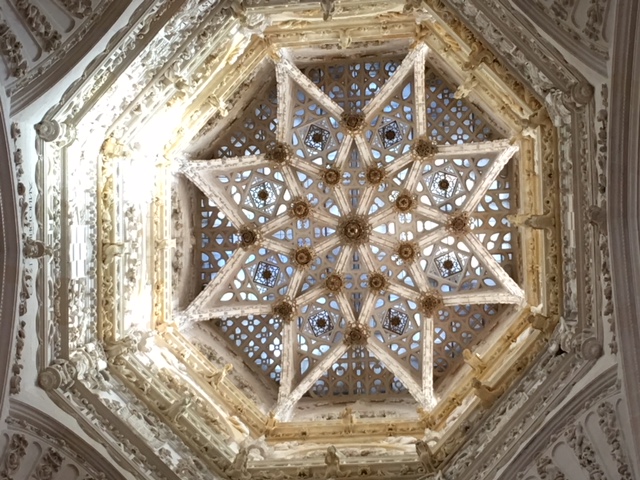
amazing ceilings

huge tapestry

because the Cathedral is built on a hill, there is an 8 metre difference
on one side, but why build just a staircase
when you can create a work of art!

Monday, October 1, 2018

Burgos Cathedral Part 2

Here are more photos of this illustrious cathedral - these are from the cloisters, of which there are two, an upper and a lower one:
a wonderfully dismissive maid

faux carving even then

four brothers in high relief

such delicate stone carving and so deep!


reflection of the towers


I love the musical angels

also great to see - modern artists' work where plain glass was before

part of the cathedral's collection of
precious objects, ignoring
where and how the ivory and gold
came from!

a particularly fine reliquary


view of one tower from the bottom cloister

detail from jewel encrusted altar cross
1:1,000 model of  Burgos cathedral


The Work of Angels Not of Men

So said King Filipe II and who are we to disagree. Burgos' cathedral is an incredible achievement, and one could spend days wandering around examining its riches, any of which could be the crown jewel in any museum anywhere. We spent three hours and came out pretty overwhelmed. Just imagine what it must have been like for a pilgrim several hundred years ago to see this grand edifice in the middle of a city of beautiful churches and towers. Of course that was the intention: to invoke awe and wonder at God's majesty that this place was built to serve.

What inspired awe and wonder in me was the speed in which it was built at a time when everything had to be hand carved and hefted into place. Originally a large but unexceptional Romanesque church, vision and enterprise changed this into one of the grandest gothic cathedrals in Europe. The first stone for this vast project was in place 1221, with the first mass given only 9 years later. The ceiling vaults were closed in 243, which means only 22 years of construction - in the 13th century!

It was added to over the following 500 years or so, with each richly carved vault, wood carving or painting or gold retablo or wrought iron gate increasing its grandeur. I think I will have the let the photos take it from here.

close up of above, every face of hundreds is differnt

exquisite tree of life, with a chaste
embrace by the Virgin Mary's
parents before the V.M. was a
twinkle in their eyes 


tapestry that lasts so many hundred years
with its colour still vibrant

demonstrative Santiago with his staff
and scallop shell

54 metre high multi-tiered vault with star-carved ceiling
like a voluptuous wedding cake

choir stall detail - carving and inlay work
and every one of all these choir stalls is different

 
another stunning ceiling
carved alabaster

deeply carved wood - amazing 'folds' of the fabric

amazing detail up close of a large retqablo

one of many, many ironwork gates

sad to see stone sickness due to damp conditions on this relief

a jewel box of a ceiling - an oval in a square space


a chapel without any unadorned space
End of Part 1